Prefer to watch it for yourself? Access the webinar on demand here.
The climate and nature crisis demands urgent action, with biodiversity declining at unprecedented rates. While over 700 organizations have committed to integrating nature into their strategic roadmaps through TNFD reporting, many struggle to translate their commitment into action, especially when supplier visibility, biodiversity data, and geospatial information remain incomplete.
The Business Case for Nature
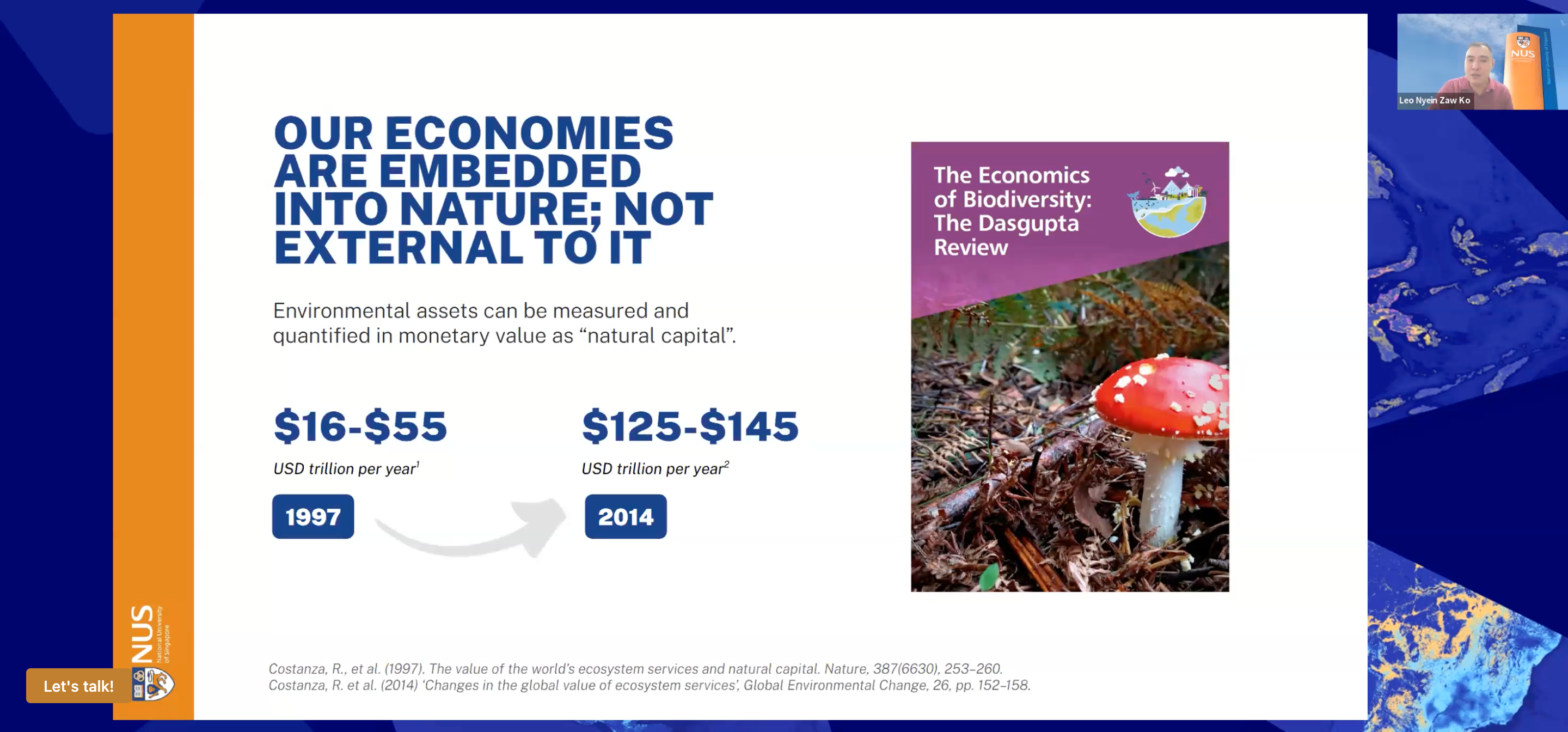
Leo Nyein Zaw Ko from the National University of Singapore (NUS) Sustainability Academy highlighted that Asia-Pacific economies are particularly dependent on nature, with 20% classified as highly nature-dependent compared to 16% globally. He emphasized that nature is no longer just a CSR checkbox; it has concrete financial implications. The estimated value of ecosystem services ranges from $125 to $145 trillion USD annually, and businesses are beginning to recognize these dependencies through frameworks like the Taskforce on Nature-related Financial Disclosures (TNFD).
The TNFD framework, which launched its final recommendations in September 2023, has seen adoption with over 700 organizations across 54 jurisdictions now committed. In Singapore alone, early-adopter companies have already published TNFD-aligned reports and secured sustainability-linked loans worth $400 million.
Nature Data Challenge and Solutions
Mike Harfoot, founding member of Open Nature and biodiversity lead in Vizzuality, addressed the elephant in the room: the nature data landscape has limitations. While biodiversity indicators show continued decline despite increasingly stringent policy targets, many organizations feel paralyzed by incomplete data. However, Mike emphasized that organizations can and should begin using the tools and data available today.
Open tools, such as ENCORE (Exploring Natural Capital Opportunities, Risks, and Exposure) and the WWF Biodiversity Risk Filter, enable companies to conduct high-level screenings of their dependencies and impacts on nature. These tools support the TNFD LEAP approach—Locate, Evaluate, Assess, and Prepare—which serves as a practical framework for managing nature-related risks.
The Open Nature Initiative is working to address data gaps by developing open species knowledge systems and ecosystem condition metrics, thereby making biodiversity knowledge more accessible, available, and actionable.

Making TNFD Actionable with Geospatial Analysis
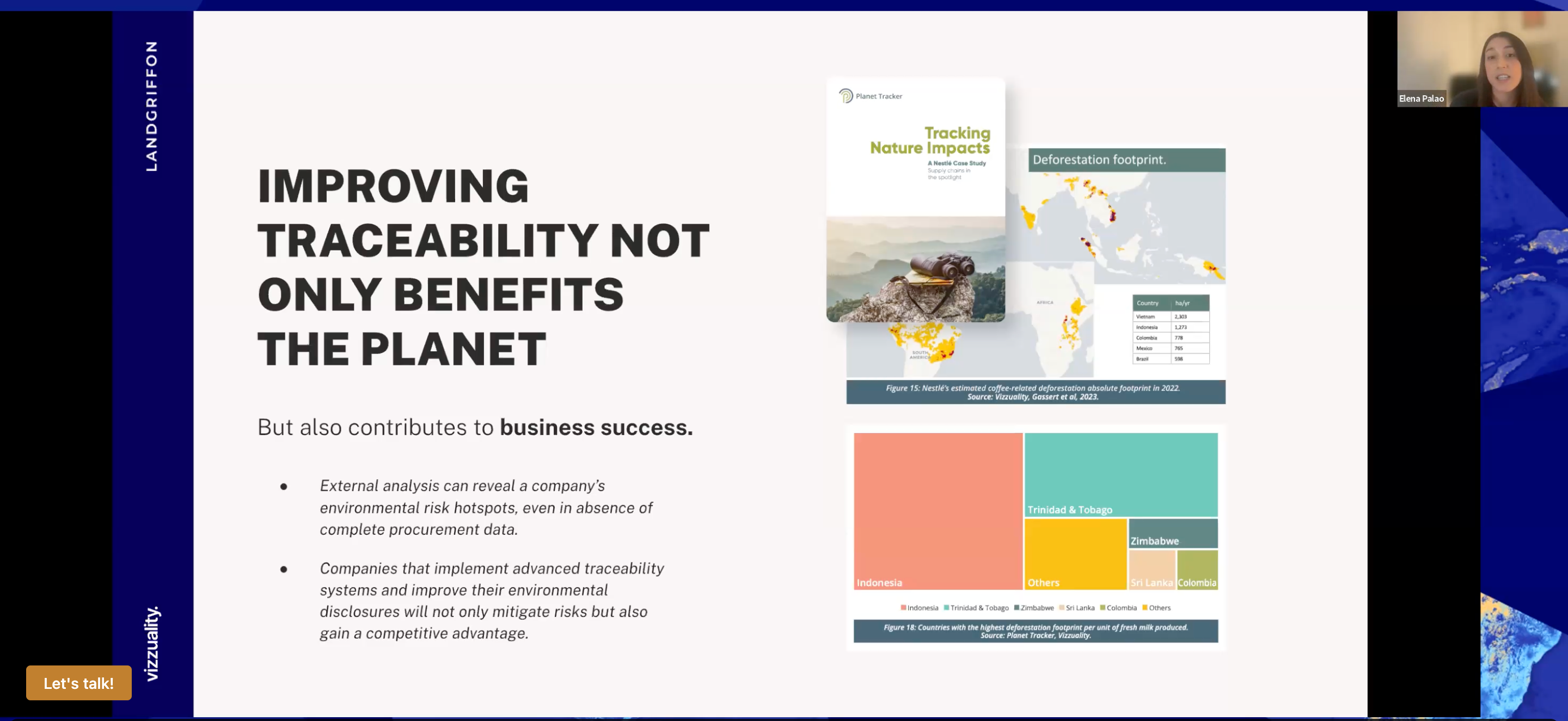
Elena Palao from Vizzuality, and product lead of LandGriffon, demonstrated how probabilistic modeling and geospatial analytics can produce decision-quality insights even when supply chain traceability is incomplete. Using tools like LandGriffon, companies can map their supply chains and estimate where production is most likely to occur, then intersect this with biodiversity indicators to quantify the impacts.
The key insight: you don't need perfect traceability to start implementing TNFD. Whether you know the exact farm location or your commodity is globally traded, geospatial analysis can identify likely high-risk sourcing areas and provide enough certainty to begin supplier engagement, risk analysis, and scenario planning.
Elena shared a real-world example where an independent nature footprint analysis using only publicly available data successfully identified environmental risk hotspots across a large food and agribusiness supply chain, demonstrating that external analysis can reveal risks even without complete procurement data.
Key Takeaways
- Start now, improve iteratively: TNFD is built for reality. It doesn't require perfect data—it requires the best available data and a clear, transparent process.
- Water is a good entry point: Unlike carbon, water is tangible, measurable, and has established methodologies. It's also easier to explain to stakeholders who pay water bills monthly.
- Use open tools: Resources like ENCORE and the Biodiversity Risk Filter can help organizations begin their TNFD journey with high-level screening and prioritization. LandGriffon takes it a step further, with an operational tool that evolves with your nature reporting.
- Geospatial analysis bridges data gaps: Probabilistic sourcing models can complement supplier surveys and audits, providing actionable insights even when traceability is incomplete.
- One analysis, multiple frameworks: The same geospatial analysis used for TNFD can support other frameworks, such as CSRD, EUDR, and SBTN, thereby reducing duplication and making nature reporting more scalable.
The message is clear: the implementation gap exists not because the tools and data don't exist, but because organizations are waiting for perfection. The time to act is now, with transparency about data limitations, leveraging available tools, and committing to continuous improvement.
Missed it? No problem, you can watch the webinar on demand here.
Something catch your attention and want to chat? Contact us now:
- Maria Ricart: maria.ricart@vizzuality.com
- Leo Nyein Zaw Ko: leo.nzk@nus.edu.sg
- Mike Harfoot: mike.harfoot@vizzuality.com
- Elena Palao: elena.palao@vizzuality.com
%20(3).png)