.jpg)
For the International Day of Women and Girls in Science.
Note: In this piece “women” also include trans women and non-binary people who experience sexism and oppression under patriarchy. Gender is a spectrum, but for readability purpose, we’ve kept the binary in our wording.
Often, people choose Science, Technology, Engineering and Mathematics (STEM) careers because of curiosity, strong problem-solving capacities, and a desire to make an impact on the world. That is also the case for women, yet despite decades of conversations about gender equity, many of them still encounter the same patterns: being treated as unusual in classrooms and workplaces, having their competence questioned more quickly, feeling pressure to over-perform, or navigating expectations around caregiving that are rarely structured into the job itself.
When these experiences show up across different people, countries, and career stages, they are not isolated anecdotes. They point us toward broader systems: How are STEM careers presented to potential students? How is competence judged at work? Whose profiles are assumed to fit the “ideal” of an engineer?
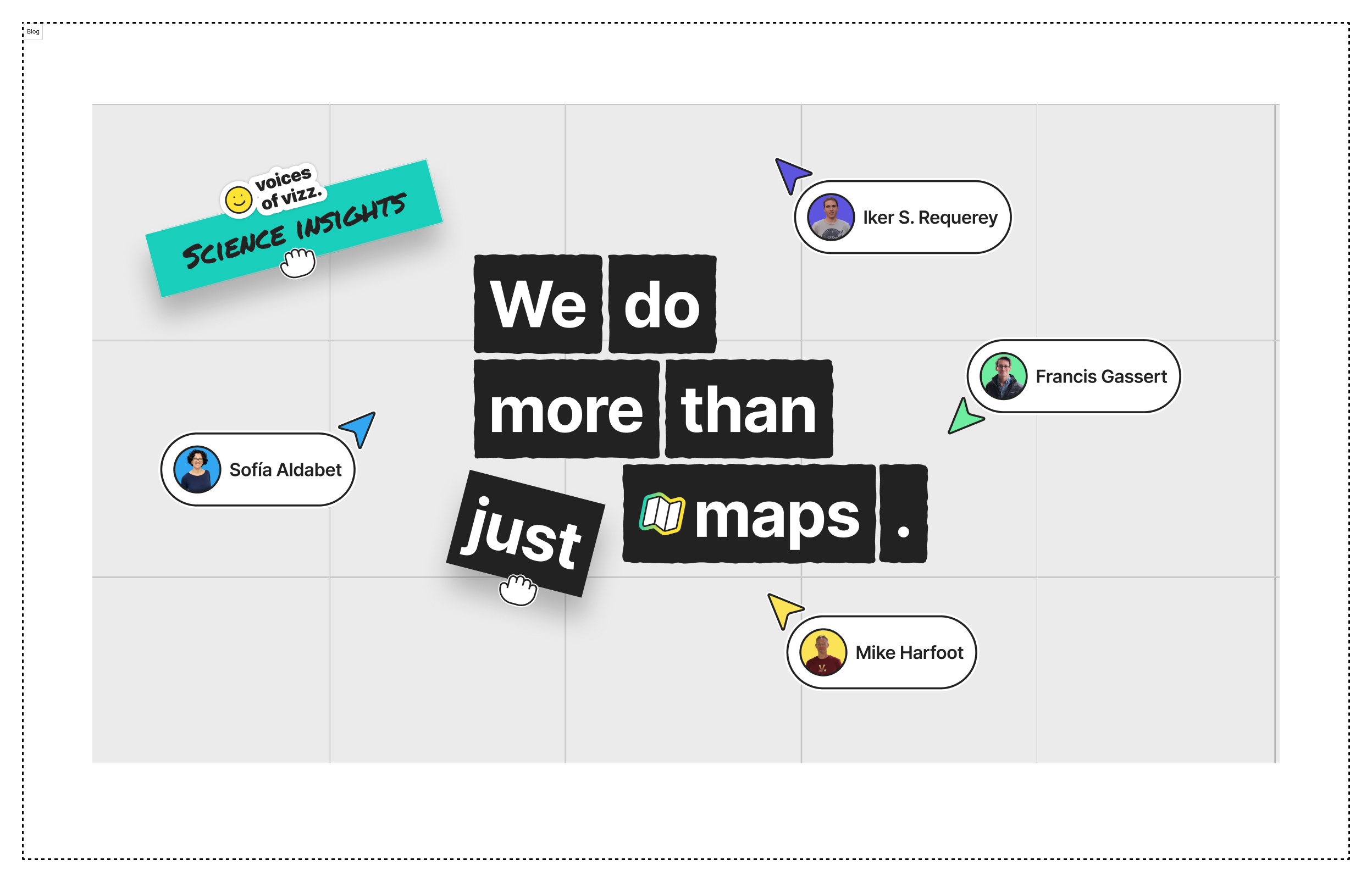
To explore this, we invited three data engineers at Vizzuality to reflect on what drew them to STEM, what supported them, and what pressures they’ve experienced along the way.
What drew them to STEM:
All three contributors spoke about being drawn to STEM from an early age by curiosity and the desire to change the world in concrete ways. However, STEM careers are often framed as unwelcoming or unusual for women, making ordinary motivations feel rather exceptional.
“My deep admiration for my dad and the everyday contact I had with computers drove me down the path of Computer Science. It almost felt like the only right path for me from a very young age, like I was carrying on a family tradition.” — Laura R.
“I grew up feeling like exploring math and science with curiosity was a normal thing for a young girl to do.” — Laura S.
“I’ve always been curious about how things work in practice, and STEM allows me to explore complex solutions with a tangible impact.” — Anonymous
Laura Stupin however noted a systemic barrier:
“Careers in STEM are often not marketed in an appealing way to women.” — Laura S.
"As a young woman, I thought that engineering was only about building skyscrapers or bridges, which were not interesting to me. It was only after my first year of college that I realized that engineering is so much more broad and beautiful. It's really about problem solving so when those problems are linked to climate change and social equity then engineering becomes very appealing to me" she added.
Her insight highlights how much framing matters. When STEM is presented as technical, abstract, or disconnected from everyday issues, it can feel uninviting. But when it is framed as a way to address climate change, equity, or community needs, it becomes deeply compelling. Who STEM is “for” and for what purpose seems to be shaped long before someone steps into a classroom.

About the importance of a support network
All three highlight how mentors, family, peer networks, and inclusive environments were crucial to their success:
“The Math and Computer Science Faculty of the University of Havana was a healthy space to grow and learn. I was listened to and valued by my peers and professors, and that environment was a key factor in shaping how I think.” — Laura R.
“At first, being the only woman in the class, I was afraid of facing sexist attitudes. I did encounter a comment — I don’t know if it was intentional — but I had the support of my classmates. I was lucky. In other engineering schools, the environment can be much more sexist.” — Anonymous
“That support, along with my mother’s insistence that I finish my studies and the opportunities offered by a public university, was key on my path.” — Anonymous
These experiences show that when support is inconsistent, informal, or unavailable, inequities widen. Access to encouragement, mentorship, financial support and public education should not depend on luck.

Belonging is a matter of environment.
We asked them what was needed for them to feel like themselves at work. Their responses highlight that belonging is about whether workplaces and schools provide the right conditions for people to contribute fully:
“Being able to contribute ideas and have them heard, without my work style or way of expressing myself being questioned.” — Anonymous
“I think representation matters, talking about women’s very real struggles matters, and creating environments where people feel safe and are encouraged to call out inequality matters.” — Laura R.
These stories highlight how systemic culture, not individual traits, shapes belonging.
The pressure to adapt
Women in STEM often face unspoken expectations and differential scrutiny. To them, the stakes are higher when making mistakes:
“It would seem that as a woman you need to excel in everything you do. Men have more room to make mistakes, while our mistakes are often treated as proof that we don’t belong.” — Laura R.
“I’ve sometimes felt that a man has doubted my judgment more than others. I don’t know if it’s because of my gender or because I seem less experienced, but I’ve felt a lack of confidence for no clear reason.” — Anonymous
These pressures, both overt and subtle, create an additional cognitive and emotional load, that not everyone is asked to carry.
Flexibility in the job description but in practice?
“If you decide to form a family and have a career, you’re still expected to take full responsibility for motherhood, housework, your job, and even how you look, while men are often praised for doing the bare minimum.” — Laura R.
“We are still expected to endure physical and mental pain (for example period-related) in silence, to keep working and be just as productive, or risk being seen as dramatic or unreliable.” — Laura R.
Balancing work and responsibilities outside the job (such as caregiving or health) depends more on workplace culture and seniority than on written policies. These accounts highlight that true flexibility requires addressing the unequal expectations placed on women.
One example of a systemic solution here could be policies like menstrual leave, equitable parental leave, or workload adjustments without loss of pay, built into the job itself. These measures recognize that care and bodily health are systemic issues that require structural support.
Conclusion: From individual character to systemic obstacles.
These voices reveal patterns that go beyond individual experiences, pointing to systemic barriers rooted in patriarchy — from double standards to unequal access to resources, including early STEM education, mentorship, inclusive workplaces, and supportive policies.
Additionally, these barriers intersect with race, class, and geography. Women of color, first-generation students, and those from underrepresented backgrounds often face compounded obstacles, including bias, fewer opportunities, and heightened scrutiny. Gender inequity in STEM cannot be understood without considering these intersections.
That's why equity in STEM is a collective responsibility:
- Simply being allowed into STEM classrooms or jobs isn’t enough. Equity requires teaching that makes the work meaningful, policies that support caregiving and health needs, and cultures where contributions are recognized without bias.
- Care responsibilities are still socially assumed to fall on women, even when anyone could perform them, shaping whose effort is recognized and whose is simply assumed.
Finally, the people navigating these systems are experts in identifying barriers and designing solutions. By centering their experiences, we can move beyond superficial fixes toward lasting change, reimagining STEM pathways, workplaces, and cultures that do truly work for everyone.

This piece was inspired by research and reporting from UNESCO, The Conversation (here and here), and EdTrust on gender equity and intersectional barriers in STEM.
.png)